
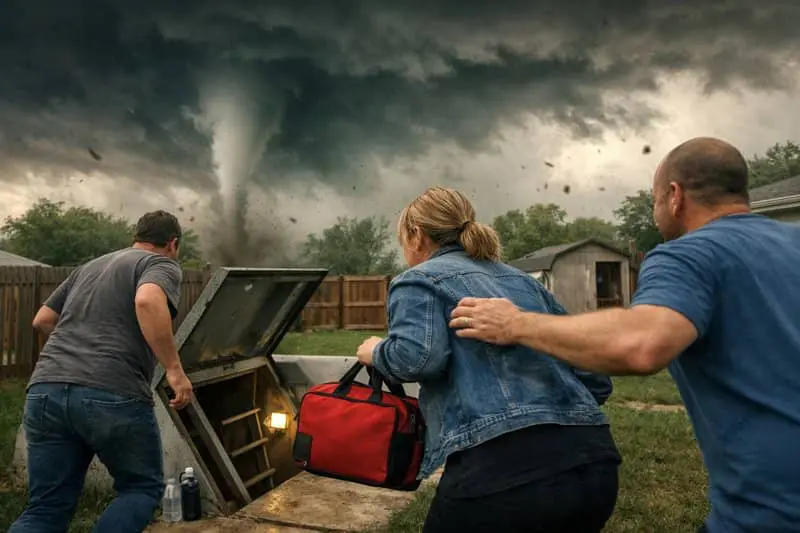
Every second matters when a tornado is approaching.
When you may have only moments to get yourself and your family to safety, you need to be able to recognize the early warning signs of an imminent tornado.
By staying alert and acting quickly, you increase your odds of reaching shelter, and your tornado shelter supplies, in time. Here’s what you need to know to stay ahead of the storm.
● Sky Shifts
Mother Nature gives you clues when a tornado is brewing, but some people don’t know what to look for.
One of the most noticeable signs is the sky turning a strange green or yellow hue. This eerie coloring comes from sunlight refracting through dense storm clouds that are packed with moisture.
If you notice this shift and feel the air grow thick and still, take it as a serious signal to stay alert.
You might also observe low-hanging, rotating cloud formations. These are not ordinary thunderstorm clouds; they may indicate a wall cloud, which is a direct precursor to a tornado.
When clouds begin to rotate horizontally, or a funnel starts to dip downward, assume the worst and prepare to move to your tornado shelter immediately.
● Wind and Air Pressure Changes
Another often-overlooked indicator is the drop in air pressure that occurs before a tornado.
You may notice your ears pop unexpectedly or feel a heavy stillness settle around you. Tornadoes feed on atmospheric instability, and a sudden calm after intense weather activity often signals a shift.
You may also be able to hear unusual wind noises. Some tornado survivors describe it as the sound of a freight train barreling toward them.
If you hear a loud, continuous roar, even if you don’t see a funnel cloud, that’s a strong sign that a tornado may already be on the ground and moving fast.
● Flying Debris
Flying debris is one of the most dangerous characteristics of a tornado.
What many people don’t realize is that you might see debris in the air before you ever spot the tornado itself. If you notice items whipping upward into the sky, the storm’s rotation has likely begun.
These wind patterns lift objects into the air with incredible force, and you should never ignore them.
Some tornadoes are “rain-wrapped,” meaning they are hidden behind heavy rain. Seeing debris in the distance might be the only visual clue you have.
If you’re in a tornado-prone region and see this kind of activity, it’s time to act.
● Unusual Animal Behavior
Animals often sense danger before humans do. Pay attention to pets or wildlife that start to act strangely.
Dogs may whimper or pace. Birds may suddenly vanish. Livestock may huddle together or attempt to flee.
While not scientific, these patterns have been reported in multiple tornado incidents and may provide another layer of warning, especially if you notice other signals at the same time.
If animals around you seem deeply unsettled, it’s wise to check local alerts and prepare to move to a safe location and hunker down with your tornado survival kit.
● Sirens and Alerts
While natural signs are important, you should always pay attention to official alerts.
Tornado sirens are designed to give you the final heads-up when danger is confirmed. If you hear the sirens in your area, don’t go outside to “see what’s happening.” Use that time to get to your pre-planned shelter location.
Your basement, a storm cellar, or a small interior room with no windows is your best option. You should also keep your tornado emergency kit stocked and at your shelter location, so you don’t waste time searching for it.
In addition to sirens, make sure your phone is set to receive Wireless Emergency Alerts (WEAs). These real-time messages come directly from the National Weather Service and can warn you minutes before a tornado touches down. For added safety, consider a battery-powered weather radio in case of power outages.
● Tornado Watches
You might feel safe during a tornado watch, thinking it’s just a precaution. After all, it’s a step below the more serious tornado warning. But you should treat every watch seriously.
Watches mean that conditions are favorable for tornado formation. That’s your cue to review your emergency plan, secure pets, and charge devices.
Once a warning is issued, the threat is real. Warnings mean a tornado has been sighted or detected by radar, and you must take shelter without delay.
Treat a tornado watch like a smoke detector. Just as you wouldn’t ignore smoke in your home, you shouldn’t delay when a tornado watch sounds. Every moment spent hesitating puts you at greater risk.
Speed and Preparedness Matter
Tornadoes move fast, some at over 50 miles per hour. Once one touches down, you may have only minutes to reach safety. That’s why recognizing the warning signs early and preparing in advance can make all the difference. Keep a tornado shelter kit in your safe area, including essentials such as water, a flashlight, first-aid supplies, and backup communication devices.
Run drills with your family so everyone knows where to go and what to bring. The more you practice, the less you’ll panic in the moment. Emergency readiness isn’t just about gear; it’s about knowing how to respond without delay.
Trust Your Senses
You don’t need to be a meteorologist to stay safe during tornado season.
If you know the basics, your body, your surroundings, and official alerts will give you what you need to know. Trust those instincts. If the sky looks off, if the air feels strange, or if sirens are wailing, react immediately. Don’t wait for visual proof or second guesses.
Being prepared means knowing the signs and being ready to move without hesitation. Your awareness and quick action make all the difference when the winds start to turn.