You’re doing a routine check of your emergency food supply kit when you spot it: a can with a visible dent. Maybe it got knocked around during storage. Maybe it arrived that way from the store. Either way, you’re standing there wondering whether it’s still safe to eat or whether it belongs in the trash.
The good news is that not every dented can is a write-off. The bad news is that some of them genuinely are. Knowing the difference could protect your family from a serious foodborne illness, which is especially important during an emergency when medical help may not be close by.
Why Dented Cans Need Careful Inspection
Canned food can stay shelf-stable for a long time, sometimes up to multiple years, which is why they form a staple part of your bunker food supplies. The can creates an airtight seal that keeps bacteria, air, and moisture out. But when that seal is compromised, the barrier fails, and what’s inside is no longer protected.
The biggest risk with a damaged can is Clostridium botulinum, the bacterium that produces botulism toxin. Botulism is rare but potentially fatal, and it thrives in low-oxygen, sealed environments, like the inside of a compromised can. According to the Centers for Disease Control and Prevention, home-canned foods are responsible for most botulism cases in the United States, but commercially canned goods with damaged seals carry a similar risk.1
What makes dented cans especially tricky is that the toxin is colorless, odorless, and tasteless. You cannot smell or see contamination. That makes the physical condition of the can itself your most reliable checkpoint, which means a quick visual and tactile inspection every time you rotate your stock is not optional. It’s the habit that keeps your supply trustworthy.
It also means that “it smells fine” is not a safety clearance. Some of the most dangerous foodborne pathogens produce no detectable signs at all. Inspect the can, not the contents.
Dents That Are Usually Safe to Keep
Not every dent signals danger. Minor surface dents in the body of a can, away from the seams and rim, generally don’t compromise the seal. Commercial cans are built from sturdy steel, and a small ding from being dropped or jostled in transit typically doesn’t create an entry point for bacteria.
Cans with “safe dents” tend to share a few characteristics. Their dents are shallow and smooth rather than jagged or creased. They may sit in the middle section of the can body, not on or near any seam. The rest of the can shows no rust, bulging, or swelling, and the can makes a solid sound when tapped rather than a hollow or pressurized one.
Run your finger across the dented area. If the metal feels firm and the surface doesn’t have sharp ridges folding inward, the can is likely structurally sound. Pair that with a clean seam inspection and a lid that shows no outward pressure, and you have a can that’s probably still good.
That said, when in doubt, throw it out. The cost of replacing one can of beans is not worth the alternative.
Dents That Should Be Dumped
Some dents are non-negotiable. These are the situations where you discard the can without tasting, smelling, or second-guessing.
Throw it out immediately if:
- The dent falls on a seam, the top rim, or the bottom rim. These are the most structurally critical areas of any can. A dent on a seam can break the hermetic seal entirely, creating a direct path for contamination, even if the can looks otherwise undamaged.
- The dent is deep, with sharp inner creases or ridges you can feel. Deep dents flex the metal enough to crack the internal enamel lining, which can leach into food and introduce additional contamination risk beyond the dent itself.
- You notice rust, swelling, or bulging anywhere on the can. Bulging is one of the clearest signs of bacterial gas production inside the can. A swollen lid means something is actively happening in there.
- The can spurts liquid, fizzes, or produces an unusual odor when you open it. Stop immediately. Do not taste it. Do not try to salvage the contents.
The United States Department of Agriculture advises that consumers never taste food from cans that are bulging or that spurt liquid when opened.2 Botulism symptoms can appear within 12 to 36 hours of exposure and include difficulty swallowing, muscle weakness, and blurred vision. It is a medical emergency that requires immediate professional care.
No dented can is worth that risk, no matter how useful the contents might seem in a tight situation.
Expiration Dates and Dented Cans
Expiration dates and dented cans are separate concerns, but they interact in ways worth understanding. Most commercially canned foods remain edible well beyond their “best by” date when the seal is fully intact. That date reflects peak quality, not a safety cutoff.
A dented can with an intact seal may still be perfectly fine to eat even if it is past its best-by date. But a dented can with a compromised seal, even a recent one from a fresh purchase, is a problem regardless of what the label says. The date on the lid tells you about quality over time. The condition of the can tells you about safety right now.
When a can is both past its best-by date and has a seam dent or structural damage, you have two separate red flags working together. At that point, the calculus tips toward discarding it. One concern alone might be manageable. Two together are not worth the uncertainty.
This is one more reason why rotating your stock consistently matters more than simply having a lot of cans on hand. A well-rotated supply means you almost never face a can that is old and damaged at the same time.
Emergency List Tip: High-acid canned foods like tomatoes and citrus typically hold peak quality for around 18 months. Low-acid foods like beans, vegetables, and meats can hold quality for two to five years. Build your rotation schedule around those ranges, and you’ll rarely be looking at a can old enough to question.
How to Store Cans Properly
The best way to handle dented cans is to reduce how often you encounter them. Emergency food storage is not a one-time setup. Your storage environment matters as much as what you choose to stock.
Keep cans off the floor and away from moisture. Humidity accelerates rust, and rust is a disqualifier even on a structurally sound can. Store cans in a cool, dry, dark space with relatively stable temperatures. Heat fluctuations cause the metal to expand and contract, which stresses the seams over time and increases the likelihood of small cracks at the edges.
When stacking, avoid placing heavy items directly on top of cans. Use wire shelving or dedicated pantry shelves where cans sit upright and have proper support beneath them. When rotating your stock, move cans carefully by hand. This decreases the risk that you’ll drop or damage them and produce the kind of dents you want to avoid.
If canned goods are part of a grab-and-go pack, check them each time you do a periodic review. Cans shift and knock against each other inside a packed bag, especially when the bag gets moved between locations or sits in a vehicle during temperature swings. A quick check during each review catches problems before they compound.
Know What You’ve Got
Dented cans do not have to be a source of confusion. Check along the seams, watch for swelling, skip anything with sharp creases or rust, and rotate your stock regularly so nothing sits long enough to become a question mark. Those habits are simple, and they make a real difference.
At Emergency List, we believe the supplies you stock should be supplies you can count on when things go sideways. A well-maintained emergency food supply for your bunker kit is not just about quantity. It’s about knowing every item in your kit is ready to do its job. Start with a quick shelf inspection today and see exactly where you stand.
Video
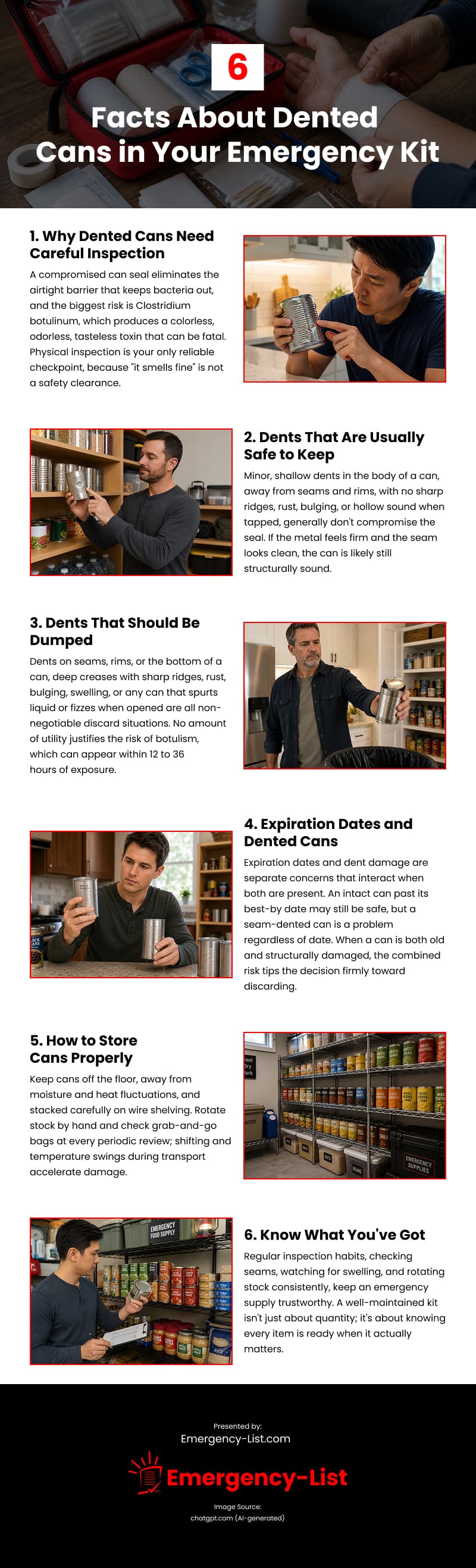
Infographic
Not every dented can in an emergency kit is a write-off, but some genuinely are, and knowing the difference matters most when medical help may not be close by. Explore facts about dented cans in your emergency kit in this infographic.